
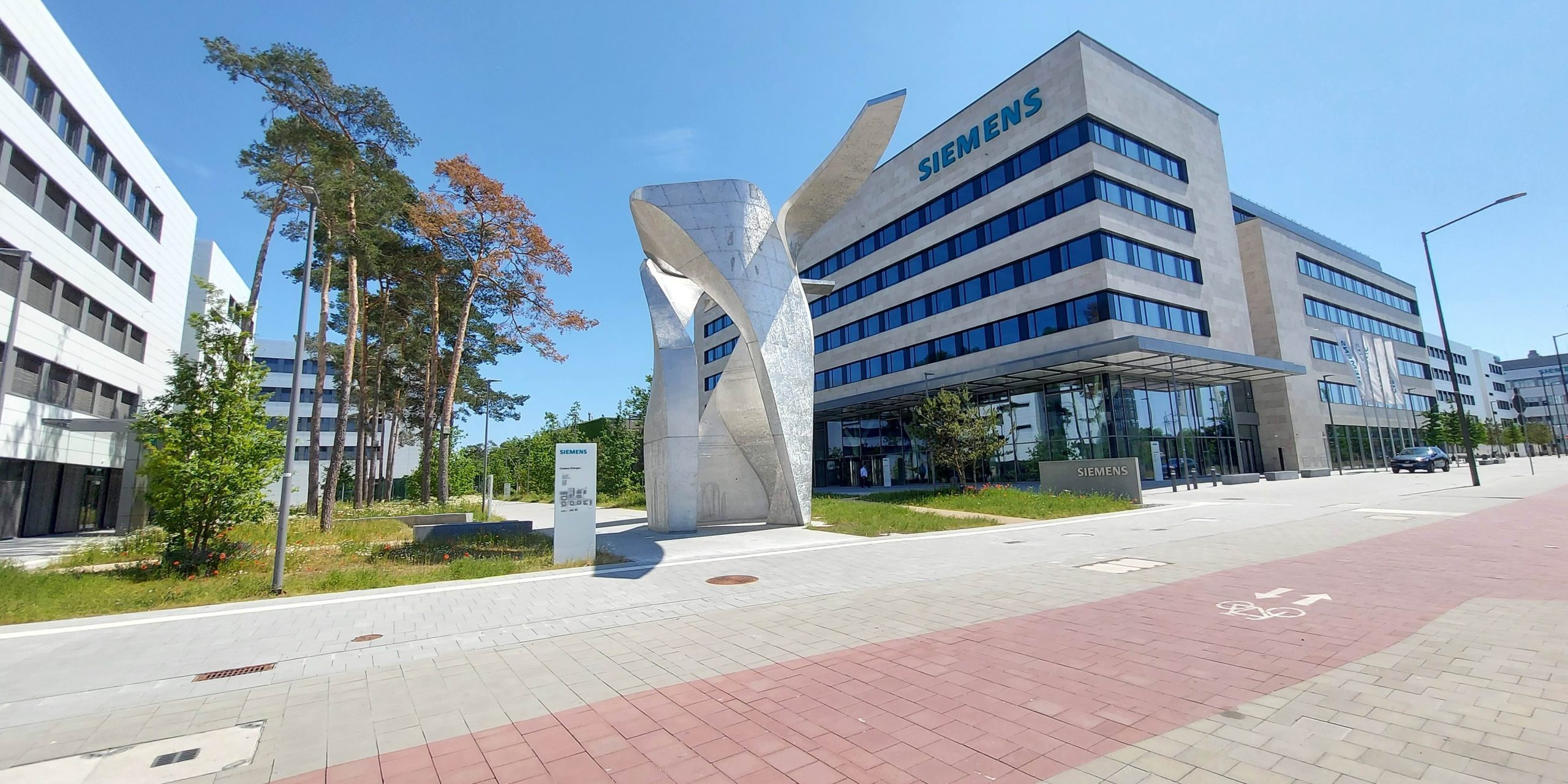
150 Years of Presence, Interrupted but Never Broken
There is a certain kind of business relationship that survives wars, revolutions, and sanctions regimes. Not because of contracts or legal frameworks, but because the infrastructure itself depends on it. Siemens AG and Iran have exactly this kind of relationship: one that stretches back to 1868, when Werner von Siemens himself oversaw the construction of the Indo-European telegraph line from London to Calcutta, routed through Tehran.
That was 158 years ago. The telegraph wires are long gone. But Siemens’ presence in Iran, in one form or another, has persisted through two world wars, the Iranian Revolution, eight years of Iran-Iraq war, and multiple rounds of crippling sanctions. No other European industrial company can claim anything close to this depth of engagement.
Today, Siemens is a different animal entirely. With €78.9 billion in revenue for fiscal year 2025 and record net income of €10.4 billion, it is one of Europe’s most valuable industrial conglomerates. Its operations span smart infrastructure, digital industries, and mobility. Iran, meanwhile, sits on some of the world’s largest energy reserves with an electricity grid that desperately needs modernization, a railway system stuck in the mid-20th century, and a healthcare sector starved of advanced diagnostic equipment.
The match is obvious. The obstacles are equally obvious.
The MAPNA Deal: Technology Transfer That Actually Worked
In March 2016, shortly after the JCPOA nuclear agreement lifted international sanctions on Iran, Siemens moved fast. The company signed a landmark agreement with MAPNA Group, Iran’s largest power engineering firm, in a ceremony in Berlin attended by Iran’s Energy Minister Hamid Chitchian and Germany’s Vice Chancellor Sigmar Gabriel.
The deal was ambitious: a long-term technology license agreement for MAPNA to manufacture Siemens F-class gas turbines domestically in Iran. Under the terms, the first six turbines would be manufactured entirely by Siemens, with gradual transfer of value-add to MAPNA. More than 20 gas turbines and associated generators would be delivered over the following decade. The first F-class turbine shipped to the Bandar Abbas power plant project in September 2016, just six months after signing.
This was not charity. Siemens had identified Iran as a market worth billions in energy infrastructure alone, with roughly 95,000 megawatts of installed capacity and plans to reach 128 GW by 2030. The average efficiency of Iranian power plants hovers around 38%, well below what modern combined-cycle technology can deliver. Replacing and upgrading that fleet represented a multi-decade pipeline of work.
The technology transfer was significant because it actually survived. Even after Siemens scaled back its Iran operations in 2018 following the reimposition of US sanctions, the know-how transfer for F-class turbine technology continued. Iran’s Energy Minister Reza Ardakanian confirmed in August 2018 that Siemens was “respecting its contracts” and its commitments on know-how transfer had not been halted.
MAPNA has since built on this foundation to develop its own MGT-75 gas turbine, a fully indigenous F-class design that demonstrates how the Siemens partnership created lasting industrial capacity inside Iran. Russia has even looked to Iran-made turbine technology based on the Siemens-licensed designs as a replacement for Siemens equipment impacted by its own sanctions challenges.
The South Pars Connection: Gas Compressors Held Hostage
Siemens’ involvement in Iran’s energy sector extended far beyond power plants. The company was a critical supplier to the South Pars gas field, the world’s largest gas field shared between Iran and Qatar in the Persian Gulf. Siemens had been supplying compressor trains and turbines for South Pars phases for two decades.
When sanctions tightened in 2012-2013, 30 Siemens gas compressors destined for South Pars phases 17 and 18 were seized and held in ports in the United Arab Emirates and the Netherlands for three years. Iran’s oil minister at the time, Bijan Zangeneh, publicly identified Germany as Iran’s “prime energy partner” in the downstream oil industry, specifically citing petrochemicals, refinery equipment, turbines, and industrial parts.
When the JCPOA lifted sanctions in January 2016, the first shipment of freed Siemens equipment arrived at the southern port of Assaluyeh within weeks. By January 2017, Siemens had signed a new contract to supply compressor trains for natural gas processing plants in Iran, with SGT-700 gas turbines driving STC-SV compressors. The order was in the “high double-digit million euro range,” according to Siemens’ own press release.
Then the window slammed shut again. In 2018, the Trump administration withdrew from the JCPOA and reimposed secondary sanctions. Siemens CEO Joe Kaeser publicly stated the company could no longer accept new orders from Iran. The company scaled back drastically, though it continued servicing existing contracts where legally permissible.
Railways: The €1.5 Billion Deal That Never Materialized
In early 2016, Siemens also signed deals worth up to €1.5 billion for Iran’s railway infrastructure. The scope was enormous: electrification of the Tehran-Mashhad line, construction of the Tehran-Isfahan high-speed railway, supply of signaling equipment, electric locomotives, passenger coaches, and maintenance services. A separate memorandum of understanding in August 2017 outlined a €3 billion credit line that Siemens was prepared to allocate for rail and power plant projects in Iran.
The 900-kilometer Tehran-Mashhad corridor is Iran’s busiest rail route, connecting the capital to the country’s second-largest city and holiest shrine. Electrification would cut travel time from 12 hours to roughly 6. The project had already been partially financed by China’s EXIM Bank with a $1.5 billion deal, with Siemens positioned as the technology provider.
None of it happened at the scale envisioned. Siemens had been supplying diesel locomotives to Iran since the early 2000s, including the ER24PC Bo-Bo diesel electrics built under Siemens design by MAPNA, and the Safir electric locomotives used on electrified routes around Tehran. The Pardis express trains, introduced in 2005, were built under Siemens license and offered premium-class service between major cities. But the big leap, full modernization of Iran’s rail network with German technology, was stopped by the 2018 sanctions return.
Today, Iran’s railway system remains a patchwork. Diesel locomotives, many aging Siemens-designed models, still haul passengers and freight. The electrification dream has been partially taken up by Chinese firms, but progress is slow.
Healthcare: The Quiet Front
Siemens Healthineers, the company’s medical technology arm, represents perhaps the most consequential area of potential engagement. Iran has a population of 88 million with a growing burden of chronic diseases and a healthcare system that relies heavily on imported diagnostic equipment.
Siemens’ MRI machines, CT scanners, and laboratory diagnostic systems are world-class. Before sanctions tightened, Iranian hospitals were significant buyers of Siemens medical equipment. The secondary sanctions regime complicated these purchases even though medical devices are theoretically exempt from US sanctions, the banking restrictions make transactions nearly impossible.
The irony is sharp: Iranian patients face longer wait times for diagnoses while European-made machines sit in warehouses or are sold instead to competing markets. Siemens Healthineers reported revenue of roughly €22 billion in fiscal 2025. Iran’s total medical device market is estimated at $2-3 billion annually. Not huge in Siemens terms, but strategically significant as a foothold in a large, young, and growing market.
What Europe Is Losing
The calculus of what Siemens’ disengagement from Iran costs both sides is not symmetrical. Iran loses access to world-class technology and a trusted partner. Europe loses something arguably more valuable: strategic influence and market position.
Consider the numbers. Before sanctions tightened in 2010, Germany was consistently one of Iran’s top trading partners in Europe, with bilateral trade regularly exceeding €4 billion annually. Siemens was the crown jewel of that relationship. By 2024, EU-Iran trade had collapsed to roughly €3.7 billion total, according to Eurostat figures analyzed in a recent IranEU post on the trade collapse.
Into the vacuum stepped China. The 25-year Iran-China cooperation program, signed in 2021, reportedly includes up to $280 billion for developing Iran’s oil, gas, and petrochemical sectors, plus another $120 billion for transportation and manufacturing infrastructure. An estimated $8.4 billion moved through a barter-like arrangement in 2024 alone, with Chinese state-owned Sinosure facilitating infrastructure investment paid for in Iranian oil.
When Siemens pulled back from railway electrification, Chinese firms filled the gap. When European turbine manufacturers became toxic for Iranian procurement officers, Chinese alternatives appeared. When Siemens Healthineers equipment became difficult to import, Chinese medical device makers gained market share.
The Renault-Iran story follows an almost identical pattern: decades of European industrial partnership destroyed in a few years of sanctions compliance, with Chinese manufacturers inheriting the market.
The Current Moment: War Compounds the Problem
As of early 2026, the situation has gotten worse, not better. The ongoing Iran conflict has created a new layer of disruption. Siemens CEO Roland Busch told Reuters in March 2026 that the Iran war has led to customers “holding back on new investments” as prices increase for raw materials and energy.
For Siemens specifically, the conflict affects its supply chain through the Strait of Hormuz. Components for major projects, including the Ineos Project One cracker in Belgium, are built in the UAE and shipped through a strait that is now a conflict zone. The company’s first quarter of fiscal 2026 still showed strong results, with orders rising 8% to €19.1 billion on a comparable basis, but management acknowledged growing uncertainty.
For Iran, the war means the already-distant prospect of sanctions relief has receded even further. The EU approved new sanctions against 19 Iranian officials and entities in March 2026 over human rights concerns. European companies looking at Iran, even those with deep historical ties like Siemens, see nothing but risk.
The Unfinished Business
What makes the Siemens-Iran story different from other European corporate retreats is the depth of embedded technology. Siemens did not just sell products to Iran; it transferred know-how. The F-class gas turbine technology that MAPNA absorbed and built upon is now indigenous Iranian capability. The locomotive designs that Siemens licensed are still running on Iranian tracks. The compressor technology that Siemens supplied to South Pars is still operating in the world’s largest gas field.
This means that when, eventually, the political climate shifts, Siemens would not be starting from scratch. The foundation is there: trained Iranian engineers who know Siemens systems, infrastructure built to Siemens specifications, a corporate memory of partnership that spans over a century and a half.
Siemens itself has shown a pattern of patient engagement. It maintained a presence in Iran even during the most restrictive periods, keeping its Tehran office open with roughly 100 employees and continuing to service existing contracts within legal boundaries. The company’s group spokesperson Yashar Azad told the Tehran Times in 2016 that Siemens “always had 100 people here and continued the execution of projects in the frame of international rules and regulations.”
That institutional patience is rare among major European industrials. TotalEnergies walked away. ENI walked away. Renault stuck around longer than most but ultimately curtailed its presence. Siemens, uniquely, never fully left.
What Would It Take?
The conditions for Siemens to re-engage meaningfully with Iran are straightforward but currently impossible: US sanctions relief or a European mechanism robust enough to shield companies from secondary sanctions. The EU’s Instrument in Support of Trade Exchanges (INSTEX), launched in 2019 to facilitate legitimate trade with Iran, was a diplomatic gesture that never achieved operational significance.
Without American acquiescence, no European company of Siemens’ scale will risk its access to the US financial system and American markets for Iranian contracts. The math is brutal: Siemens’ US operations generate more revenue in a month than its Iran business could produce in a decade.
But the strategic case for re-engagement, whenever it becomes politically feasible, remains compelling. Iran needs an estimated 25,000 megawatts of new power generation capacity over the next decade. Its railway network requires tens of billions in investment. Its hospitals need modern diagnostic equipment. Its factories need automation and digitalization technology, areas where Siemens is now a global leader.
China will build much of this. But Chinese technology, while improving rapidly, still does not match German industrial engineering in reliability, efficiency, and long-term operational support. Iranian engineers and procurement officials know this. They have worked with both.
The century-and-a-half relationship between Siemens and Iran is a reminder that industrial partnerships can outlast political crises. Siemens helped build Iran’s first telegraph connection to Europe. It supplied the turbines that light Iranian homes. It designed the locomotives that connect Iranian cities. It equipped the hospitals that treat Iranian patients.
All of that infrastructure is still there. So is the knowledge transfer. So, quietly, is Siemens’ willingness to return. What’s missing is the political permission slip.


2 Comments